Showing posts with label Malaysian Tradition. Show all posts

Tuesday, April 21, 2009

Ang Pau (Red Packet)

Chinese New Year or Chinese Spring Festival is one of the most important cultural celebration among the Chinese in China or Oversea Chinese especially folks of Han origin. It is also called Lunar New Year owing to its origin whereby this festival begins on the first day of the first lunar year.

Unlike Gregorian calendar which is a cumulative number as time passed, in Chinese lunar calendar or sometimes interchange as Chinese Zodiac, twelve animals are used as symbols in their counting system and they are repeated after a cycle of 60 years. To make up for a complete 60-year rotation, the twelve animals years are also influenced by five elements of metal, wood, water, earth, fire and the concept of yin and yang.

From mythical perspective, Chinese New Year began with the fight against a wild fierced beast called 'Nian' (in Mandarin, 'Nian' also co-incidentally means 'Year') on the first day of lunar calendar. It was believed that 'Nian' would come and destroy livestock, crops and attack villagers especially children. In order to protect themselves, the villagers set up a plan; they placed all the red banners outside their houses, burnt firecrackers to make a loud noise and danced with lion heads. Believe it or not, these plan seemed worked and on the following year, this beast never turn up again.

Nowadays, Chinese New Year or Spring Festival is celebrated at varying degree depending on geographical region. In fact, the celebration of Chinese New Year lasted for 15 days from the 1st day of lunar calendar until the 15th day. In Malaysia whereby Chinese comprises about 30% of Malaysian population, it is observed as national public holidays on 1st and 2nd day of Chinese Lunar calendar. On the Chinese New Year eve, all the family members from far or near will usually be home for a reunion dinner and enjoy sumptuous meals together.

One of the tradition during Chinese New Year is wearing new clothes of red color. It was believed to scare away the evil sprits or bad fortunes. Giving red packet or red envelope ('Hong Bao' in Mandarin or 'Angpow' in Hokkien) to children is also widely practised whereby in these red packets, some cash notes are inserted. The common practice will avoid giving the cash amount in odd number. According to tales, the first red packet was given to a brave orphan boy by an elderly villager when he managed to defeat a dragon-like demon in recognition of this courage for saving the Chang Chieu villagers during Sung Dynasty. Since then, these envelopes are distributed by elderly or married couples as it symbolises courage, good luck and wealth in abundance.

This is an another example of Malaysia's extraordinary other than cultural exchange of the Malay wedding ceremony, which incorporates elements of the Hindu traditions of southern India; the bride and groom dress in gorgeous brocades, sit in state, and feed each other yellow rice with hands painted with henna. Muslims have adapted the Chinese custom of giving little red packets of money (ang pau) at festivals to their own needs; the packets given on Muslim holidays are green and have Arab writing on them.

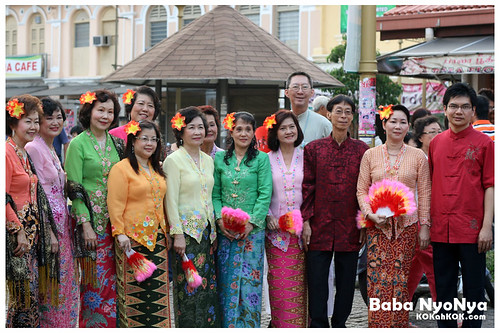
Melaka Baba Nyonya


Distinctive Cultural Heritage

The origins of Baba Nyonya can be traced back to centuries ago when the Chinese emigrated from China to the British Straits Settlement of Melaka, Singapore, Penang and also Java of Indonesia. The Chinese then married the local females and their distinct background, cultures and customs blended together harmoniously and became baba nyonya in “Peranakan” culture.

“Peranakan” means descendent in Malay. It is another local term for them. “Baba” refers to the male while “nyonya” is female. Beside, they are also being known as “Straits-born Chinese”. This is a very unique culture in Melaka where the Chinese culture is assimilated into Malay customs. During the ancient time, they retained some practices of Chinese cultures but at the same time adapted local Malay traditions in order to minimize the culture shock.

Assimilated into Malay culture, they have several similarities with that culture in terms of dress, food and language. Nyonya is usually wearing sarung or baju kebaya similar to Malay. However, most of them are not Muslim even though they practice Malay traditions. They retained some Chinese customs especially in festival celebrations, marriage, names and ancestral worship.

Mentioning about nyonya food, one will be salivating and food like Kapitan chicken, buah keluak, duck sup, laksa and various mouth-watering sweet delicacies will come to the mind. Adapt both cultures in cooking; nyonya food is made up of pungent and strong-flavored spices from Malay and Chinese style in food preparing. Thus, you might probably find some cuisines similar to Malay food but contain pork.

They speak in a form of “assimilated language” consisting of Baba Malay, Malay Patoi and Hokkien dialect. Thus, you might be surprised by the way they speak in a mixture of Malay language, Hokkien dialect and probably some unfamiliar terms for you. It is said that their language is a blend of Chinese, Malay and Eurasian culture because European like Dutch was influential when they dominated Melaka last time. Their languages itself is amazing enough in telling you how one culture can assimilated into another and create another novel and unique culture.

Friday, April 17, 2009

Wayang kulit (Shadow Puppet)

Wayang Kulit
Wayang Kulit is a popular shadow puppet show in the East Coast of Peninsular Malaysia, especially those in Kelantan and Terengganu, and also in Johor. The origin of the theatre is still remained a mistery, but it was brought to Malaya hundreds of years ago.Wayang Kulit is a very unique form of theatre employing the principle of light and shadow. The puppets are crafted from buffalo hide and mounted on bamboo sticks. When held up behind a piece of white cloth, with an electric bulb or an oil lamp as the light source, shadows are cast on the screen.

Wayang Kulit plays are invariably based on romantic tales, especially adaptations of the classic Indian epics, "The Mahabarata" and "The Ramayana". Some of the plays are also based on local happenings (current issues) or other local secular stories. It is up to the conductor or "Tok Dalang" to decide his direction.

The Tok Dalang is the genius behind the entire performance. It is he who sits behind the screen and narrates the story. With a traditional orchestra in the background to provide a resonant melody and its conventional rhythm, the Tok Dalang modulates his voice to create suspense thus heightening the drama. Invariably, the play climaxes with the triumph of good over evil.

Wayang is an Indonesian/Malay word for theatre. When the term is used to refer to kinds of puppet theater, sometimes the puppet itself is referred to as wayang. ", the Javanese word for shadow or imagination, also connotes "spirit." Performances of shadow puppet theater are accompanied by gamelan in Java, and by "gender wayang" in Bali.

UNESCO designated Wayang Kulit, a shadow puppet theater and the best known of the Indonesian wayang, as a Masterpiece of Oral and Intangible Heritage of Humanity on 7 November 2003.

Four varieties of shadow play are active in the Malay peninsula:

(a)Wayang Kulit Siam,
(b) Wayang Kulit Gedek,
(c) Wayang Kulit Purwa and
(d) Wayang Kulit Melayu.


Wayang Kulit Siam is the most indigenous of these styles. It is principally performed in the state of Kelantan on the east coast of the Malay peninsula. Wayang kulit siam makes use of a local version of the Indian epic, Ramayana. Existing only in the oral tradition, this version is known as Hikayat Maharaja Wana.

The Hikayat Seri Rama provides material for the principal story (cerita pokok). Local extensions of and accresions to the epic have resulted in the creation of a large number of Ramayana branch stories (cerita ranting). These have traditionally been more popular than the pokok story.


The wayang kulit siam orchestra consists of a pair of double- headed drums(gendang), a pair of single-headed goblet-shaped drums known as gedumbak, a pair or vertically standing drums (gedug) hit with beaters, a pair of hand small cymbals, (kesi) and a pair of inverted gongs canang), also beaten with sticks. and, finally, a pair of hanging knobbed gongs(tetawak).


Wayang kulit siam peformances are done in two varieties:

(a) those done purely for entertainment and
(b) those intended for ritual purposes such as the salutation of teachers (sembah guru).

Ritual performances,known as wayang kulit berjamu,are extremely rare.They incorporate a host of ritual acitivities as well as trance.

Silat Cekak with parang lading


Parang Lading is the official weapon of Silat Cekak Ustaz Hanafi, one of the main leading silat organisation in Malaysia. It was smithed according to specific measurements of the owner, thus making it a perfect combat companion. Any error on the smith's part could cause the weapon to 'makan tuan' or accidentally hurt its owner.

Monday, April 13, 2009

Silat

It is not known exactly how old silat is but it can be traced back to the kingdom of Srivijaya. Indian martial arts had an impact on Southeast Asian styles, evident from the use of silambam staffs and the thigh-slapping found in many forms of silat which is reminiscent of Hindu wrestling for example. Bas-reliefs in Srivijaya which clearly illustrate warriors wielding weapons such as the Chinese double-edged sword also suggest Chinese influence.

There are a number of legends of how silat was created but only one has any historical significance. The story tells of a Sumatran woman who witnessed a fight between a tiger and a very large bird while fetching water from a well.

Both animals, unfortunately, died in the fight. The woman's angry husband came to scold her for her tardiness but she blocked all of his attacks, remembering the movements of the fighting animals that she saw earlier. The couple later formulized the art and founded the first style of silat (sometimes said to have been Silat Harimau). However true this story is, archeological evidence shows that silat was indeed created in Sumatra and flourished after it spread to Java.


By the 15th century, silat was already highly refined. Besides the similarities to martial arts from China, India and other Southeast Asian nations, silat also bears a resemblance to karate and Japanese weapon arts, such as tessenjutsu and bojutsu.

This is not surprising since Okinawa traded with both Java and Melaka. Some Okinawans still have South-East Asian facial features which indicates that silat also must have influenced karate. After Dutch colonization, silat spread to Holland from Indonesian immigrants. It still remains one of the most popular Asian martial arts in the Netherlands.